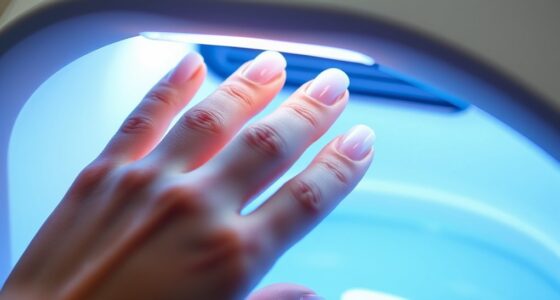
Higher lamp wattage delivers more intense UV light, which is vital for quick and effective curing of materials. It guarantees the proper wavelength activation of photoinitiators and provides sufficient energy to reach thicker or hard-to-reach areas. While increased wattage speeds up curing and improves bond quality, it can also generate more heat, so balancing wattage with temperature control is necessary. To discover how to optimize your curing process, keep exploring further.

Get beauty and skincare favorites delivered free with Prime
- Fast, free delivery on millions of items
- Prime Video, Amazon Music and more included
- Member-only deals all year
Key Takeaways
- Higher wattage lamps deliver more intense UV light, leading to faster and more complete curing.
- Adequate wattage ensures sufficient UV wavelength emission for effective polymerization.
- Increased wattage can raise curing temperatures, potentially risking material damage or patient discomfort.
- Proper wattage balances curing speed and temperature control for optimal bond strength.
- Insufficient wattage may result in incomplete curing, compromising material properties and durability.

Choosing the right lamp wattage is vital for ideal cure performance in dental and industrial applications. When you select a lamp with the appropriate wattage, you’re guaranteeing that the UV wavelength emitted is sufficient to activate the photoinitiators in your resin or adhesive. A higher wattage lamp typically produces a more intense UV output, which can accelerate curing times and improve the overall quality of the bond. However, it’s important to balance wattage with other factors, such as the curing temperature, because excessive heat can lead to material distortion or discomfort in dental procedures.
Choosing the right wattage ensures effective UV wavelength activation and optimal curing performance.
The UV wavelength emitted by your lamp directly influences how effectively the material cures. Different materials are sensitive to specific wavelengths, and a lamp with inadequate wattage may not generate enough UV light at the required wavelength, leading to incomplete curing. A well-chosen wattage ensures the UV wavelength penetrates thoroughly, activating the chemical reactions needed for proper polymerization. This is especially vital when working with thicker materials or surfaces that are hard to reach, as higher wattage lamps can deliver the necessary energy more efficiently. Understanding the wavelength emission of your lamp can help you select the most suitable wattage for your specific material, ensuring optimal curing efficiency. Additionally, considering light intensity can help optimize curing times and energy consumption for your project.
Curing temperature also plays a key role in how the lamp wattage impacts performance. As you increase the wattage, the curing process often produces more heat. If the lamp wattage is too high, the temperature may rise beyond ideal levels, risking damage to the material or patient discomfort in dental settings. Conversely, insufficient wattage may result in lower curing temperatures, prolonging the process and potentially compromising the final strength and durability of the cured material. Proper temperature management helps maintain the right conditions for effective curing without overheating. Maintaining a proper curing temperature ensures that the material reaches its perfect state without overheating, which can cause warping or shrinkage. Additionally, understanding how light intensity relates to your curing process can help you select the most effective wattage to maximize efficiency and safety. Proper management of wattage and temperature can also influence the durability and long-term performance of the cured material.
As an affiliate, we earn on qualifying purchases.
Frequently Asked Questions
How Does Lamp Wattage Impact Curing Speed?
Higher lamp wattage increases curing speed because it enhances light penetration, allowing the light to reach deeper into the material more quickly. Additionally, more wattage generates more heat, which can accelerate the curing process. However, too much heat might cause issues like material distortion or discomfort. You should balance wattage to optimize curing speed without risking damage, ensuring efficient and safe results.
Can Higher Wattage Cause Over-Curing or Damage?
Higher wattage can cause over-curing or damage if you’re not careful. Over-curing risks include excessive brittleness or discoloration, which compromise your material’s strength and appearance. To prevent damage, monitor curing times closely and avoid leaving the lamp on too long. Using the appropriate wattage for your specific application helps guarantee effective curing without risking over-curing or damage, keeping your results consistent and durable.
Is There an Optimal Wattage for Specific Resin Types?
You should choose a lamp wattage based on resin compatibility and desired curing temperature. Higher wattages can speed up curing but might risk over-curing or damaging sensitive resins. For delicate or specialty resins, lower wattages guarantee proper curing without overheating. Always check the resin manufacturer’s recommendations for best wattage; this guarantees effective curing while maintaining the resin’s properties and avoiding issues caused by excessive heat.
How Does Lamp Distance Affect Cure With Different Wattages?
Imagine UV light so intense it could melt steel—well, that’s how essential lamp distance is! When you adjust the distance, it dramatically impacts curing consistency. With higher wattages, moving the lamp even a tiny bit farther can weaken the cure, creating weak spots. Conversely, closer proximity with lower wattages guarantees even UV light exposure, assuring a strong, thorough cure every time. Distance truly makes all the difference!
Are Lower Wattage Lamps More Energy-Efficient?
Lower wattage lamps are generally more energy-efficient because they consume less power, leading to energy savings. This efficiency reduces your environmental impact by lowering electricity use and emissions. Although they may take slightly longer to cure, using lower wattage lamps can be a smart choice for eco-conscious practices. You’ll save energy and help protect the environment without sacrificing the quality of your curing process.
As an affiliate, we earn on qualifying purchases.
Conclusion
So, if you crank up that lamp wattage, you’re not just improving your cure—you’re releasing a lightning storm of unstoppable strength! Higher wattage amps up the power, speeds up the process, and makes your curing job feel like a breeze. Forget slow, forget weak—embrace the wattage revolution and watch your results transform from average to mind-blowingly perfect in record time. It’s not just a cure; it’s a cure on steroids!
As an affiliate, we earn on qualifying purchases.
As an affiliate, we earn on qualifying purchases.
Fall Picks
fall essentials
As an affiliate, we earn on qualifying purchases.